Research from U.S. spine centers points to an “antimicrobial” synthetic graft that reduced the risk of deep infection by fivefold in patients undergoing lumbar fusion.
COLUMBUS, GA — A newly published multicenter study has found that patients undergoing an established and common type of lower-back fusion surgery had a substantially lower risk of serious surgical site infection when their surgeon used a specific synthetic bone graft material known as 45S5 bioactive glass (“bioglass”), compared with other widely used graft materials.
The study, published in the Journal of Spine Surgery, reviewed the primary records of 1,376 patients who had posterior transforaminal lumbar interbody fusion (TLIF) — a procedure used to stabilize the spine and relieve pain from conditions such as spinal stenosis and instability — at participating U.S. centers between 2017 and 2022. Patients who received the Synergy BioSphere 45S5 bioglass bone graft had a deep infection rate of 0.6%, compared with 2.7% in those who received other graft materials. After accounting for differences between patients, this translated into a highly significant, fivefold reduction in the risk of infection after surgery.
Surgical site infection is one of the most feared complications after spine surgery. It can lead to additional operations, prolonged recovery, chronic pain, and high cost to patients and health systems. Even with today’s best prevention practices, infection rates after this type of fusion have remained between 2–7%.
What makes bioglass notable is that it appears to do two jobs at once. It is already an established and remarkably effective material for helping bone heal and fuse. But 45S5 bioglass also has natural antimicrobial properties — long demonstrated in laboratory studies — that make the local surgical environment less hospitable to bacteria without relying on antibiotics. This study is, to the authors’ knowledge, the first to show that laboratory-observed properties may translate into fewer real-world infections in patients after spinal fusion surgery.
“Bone graft is something every spine surgeon uses, but it hasn’t traditionally been thought of as a tool for preventing infection,” said Dr. Lance Erik Westerlund of Hughston Clinic, the study’s senior author. “These findings suggest that the choice of graft material itself may help protect patients — offering a potential added layer of defense against one of the most serious surgical complications we work to avoid.”
Importantly, the two patient groups healed and fused at the same high rate, and had similar reoperation rates — indicating the infection benefit did not come at the expense of the graft’s primary job of promoting successful bone fusion.
The implications extend beyond the United States. 45S5 bioactive glass graft materials are used by spine surgeons worldwide, and the biological properties described in the study are inherent to the material rather than to any single region or practice setting. The findings may therefore be relevant to patients and surgeons internationally as they weigh options for lumbar fusion.
The authors emphasize that, despite the study’s size and ambition, it was retrospective, meaning it observed outcomes in patients who had already been treated rather than randomly assigning them to a graft type. As a result, it can demonstrate a strong association but cannot by itself prove that bioglass caused the lower infection rate. The researchers call for prospective, randomized clinical trials to further confirm the findings.
“We hope that this work encourages the larger, forward-looking studies needed to establish this benefit definitively,” Dr. Westerlund said. “If further confirmed, it could be another practical step toward safer spine surgery for patients everywhere.”
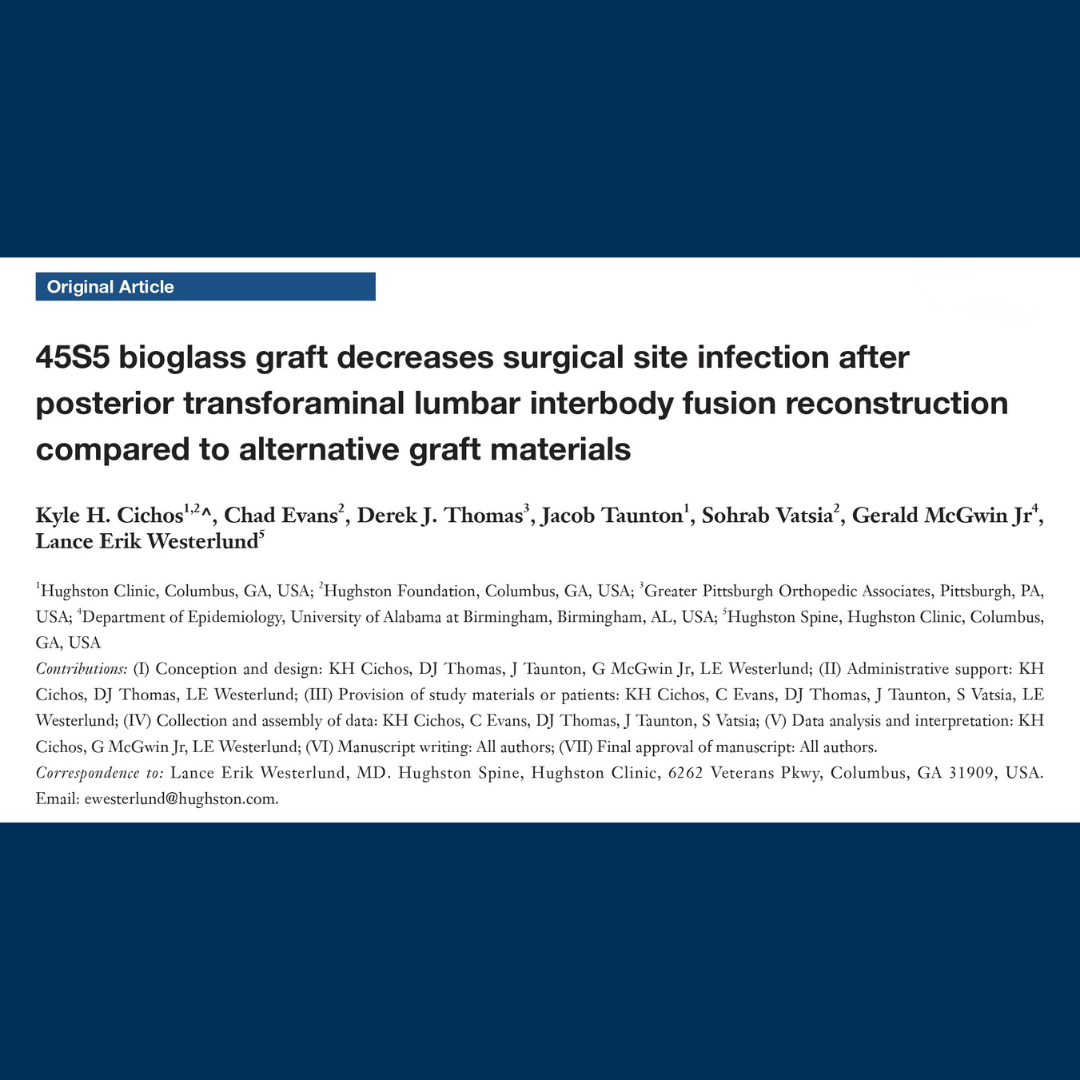
The study, “45S5 bioglass graft decreases surgical site infection after posterior transforaminal lumbar interbody fusion reconstruction compared to alternative graft materials,” is available open access in the Journal of Spine Surgery (DOI: 10.21037/jss-2025-1-205).
Last edited on July 10, 2026