
Have you had a persistent tingling sensation in your ring and pinky fingers, along with a dull ache on the inside of your elbow? If so, you may be suffering from cubital tunnel syndrome. The condition results from increased pressure on or compression of the ulnar nerve at the elbow. It affects about 30 in every 100,000 people each year, making it the second most common nerve compression problem in the upper arm. Fortunately, with an early diagnosis, your doctor can help ease your symptoms and restore normal nerve function using activity modifications, medications, physical therapy, or surgery.
Causes
Physicians cannot always determine the exact cause of cubital tunnel syndrome; however, the ulnar nerve is vulnerable to compression at the elbow. When you bend your elbow, you compress and stretch the nerve, reducing its blood supply; thus, your symptoms worsen during the movement. Compressing the ulnar nerve can also result from a fracture, tumor, osteophyte (bony growths that occur as part of degenerative arthritis), ganglion cyst (fluid-filled lumps appearing near joints and tendons), or heterotopic ossification (bone forming in muscles or other soft tissues). You can also compress the nerve by leaning on your elbow for long periods or from a direct impact to the elbow, also known as hitting your funny bone.
Risk factors
Risk factors for cubital tunnel syndrome include activities that require bending the elbow for long periods, such as using a computer or playing a musical instrument. Other factors can include age, previous elbow fractures or dislocations, bone spurs, arthritis, and sports that require the use of the elbow, such as baseball, football, and tennis. The condition affects males more than females; however, it often affects females at an earlier age.
Symptoms
With cubital tunnel syndrome, patients often experience numbness and tingling in the ring and pinky fingers, and difficulty with bending and extending their fingers. In severe cases, you can experience difficulty with grip strength and/or finger coordination, and if it has been going on for some time, you can suffer muscle loss in the hand that treatment cannot reverse. Most symptoms affect the hands and are accompanied by a dull pain in the elbow. If the symptoms are severe, or less severe but have been present for more than 6 weeks, then you should see your doctor.
Screening and Diagnosis
When a patient first presents to clinic with symptoms of cubital tunnel syndrome, the physician often begins with performing a physical exam. The doctor can perform the Tinel’s Sign test that detects irritated or injured nerves by tapping over the nerve, which can cause a shocking sensation in the ring and pinky finger. During the exam, the physician can determine whether the ulnar nerve slides out of the normal position when you bend your elbow, move your neck, shoulder, elbow, or wrist, and can check the strength in your hands and fingers. The physician can also order x-rays of the elbow to see if bone spurs or arthritis are causing ulnar nerve compression, as well as a nerve conduction study, also known as electromyography (EMG), which measures the muscle response to nerve stimulation.
Complications
If left untreated, cubital tunnel syndrome can lead to permanent nerve damage, which can cause ongoing pain and numbness in the hands and fingers. The syndrome can also cause muscle weakness, making it hard to perform day-to-day tasks. Over time, the muscles in the hand can shrink and waste away, a process that may not be reversible. In severe cases, the ring and pinky fingers may curl into a claw position, making it impossible to open the hand and use it properly. There can also be recurrence and neuroma formation (a ball-shaped mass at the site of a nerve injury). Effective and early treatment is key to maintaining normal hand functions and avoiding long-term complications.
Treatment
Treatment options vary from person-to-person depending on the severity of the problem. There are nonsurgical and surgical treatment options. Nonsurgical treatment involves avoiding pressure on the affected elbow and keeping the elbow straight. Your physician can recommend a brace or splint to stabilize the elbow and prevent bending. Other nonsurgical options include nonsteroidal anti-inflammatory medications (NSAIDs), such as ibuprofen or naproxen, which reduce inflammation, swelling, and pain around the nerve. Your doctor can prescribe physical therapy to strengthen the muscles around the nerve and improve flexibility.
Your physician may recommend surgery if the nonsurgical options have not shown improvement (Fig.), if the ulnar nerve compression is severe, or if the nerve compression has caused muscle weakness and damage. In a cubital tunnel release, the surgeon releases the tight tissues that are pressing on the ulnar nerve, giving it more space and reducing the pressure. Even simply moving the nerve over the medial epicondyle of the elbow eases its compression and stretching during bending. This is called nerve transposition.” Another surgical option, medial epicondylectomy, involves the surgeon removing part or all of the medial epicondyle (a bony prominence of the elbow), thereby creating more space for the nerve. This procedure prevents the nerve from being pinched, resulting in reduced pain and improved movement.
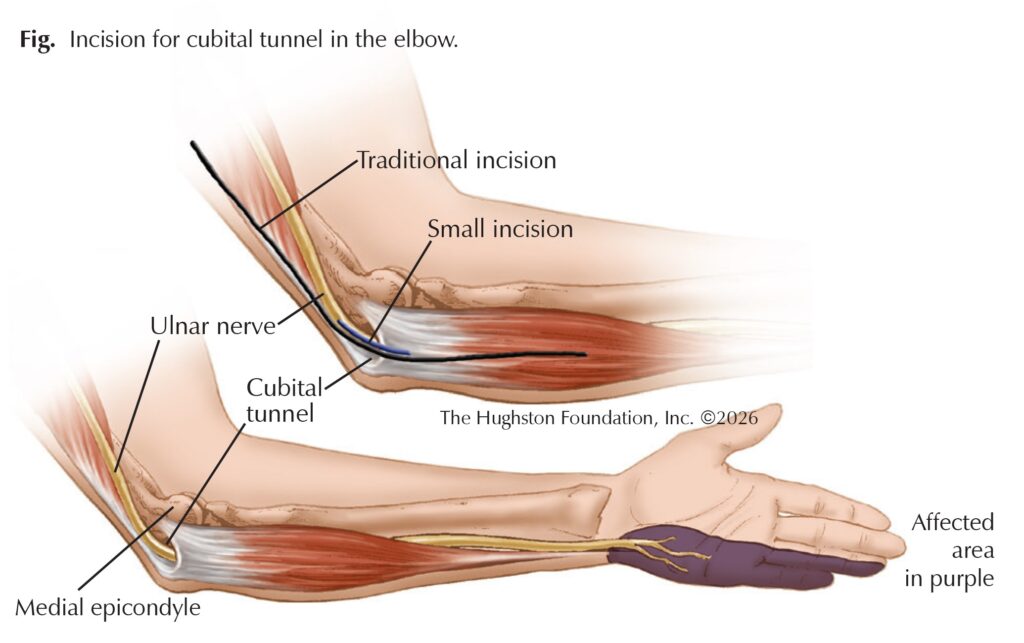
Among the many options, your doctor will discuss which procedure best suits you, given the severity of your condition. Depending on the type of surgery, you may wear a splint for a few days or weeks, then begin physical therapy to regain strength and range of motion in the arm.
Outcomes
Most patients report improvement immediately after surgery; however, recovery can take time, and not all symptoms may resolve. Not everyone responds the same way, and while most patients do improve, follow your doctor’s advice and give your body time to heal. Adapting to the limitations and working with your doctors can help manage the condition better.
To prevent cubital tunnel syndrome, stretch before doing intensive activities such as sports, avoid compressing your elbow for long periods, take breaks if you do, switch sides, change positions, and avoid repetitive movements. Staying active, using good techniques, and taking regular breaks can help prevent the condition.
Author: Prit Patel, MS | Columbus, Georgia
Last edited on September 23, 2026